

Last week I sent $36 to Manny Yekutiel. I don’t know him, and I don’t owe him money. But I was moved by what he said at a press conference earlier this summer after his San Francisco restaurant, Manny’s, was ransacked and defaced with anti-Israel and antisemitic graffiti, like “Intifada,” “F___Manny” and “Die Zionists.”
Manny said he got a a call at night from a customer attending an event at the restaurant, which also serves as a community space.
“There’s someone trying to break down the windows,” the caller said, “I don’t know if I’m safe here.”
Civic leaders stood by Manny, who reopened his restaurant and launched a fundraiser to help support it.
As I searched for the donation page, I stopped to read Manny’s menu — I mean, food, right? There were chilaquiles, avocado toast, bagel sandwiches, seared ahi, Beyond Burgers, a crispy chicken sandwich, along with the usual coffee drinks and IPAs. No hummus. No falafel.
“I’m not even Israeli,” Manny, who comes from a Afghanistan Jewish family, said of the graffiti.
Not that it’s okay to attack Israeli restaurants, or Palestinians ones for that matter. In Philadelphia, vandals threatened a falafel restaurant. In Miami they defaced a new place partly owned by the Israeli chef Eyal Shani.
And their thug cousins did the same to restaurants where Palestinian work, defacing one in 2024 in San Francisco with anti-Arab graffiti and harassing and review-bombing another co-owned by the Palestinian chef Reem Assil shortly after Oct. 7.
Why has food and the places that serve it has become a surrogate battlefield?
Fighting here, because of hunger there
One answer is that, in Gaza, food has become a tragic part of the conflict.
From the beginning of Israel’s attack on Gaza, Israel’s critics were accusing it of carrying out a genocide-by-starvation in the narrow strip. They were wrong.
But when Israel decided to enforce a total blockade this past March, credible reports of severe malnutrition emerged.
International authorities recently concluded that there is a famine in northern Gaza, and that Gazans have died from lack of food due to Israeli policies. Israel officially disputes that assessment.
This week the country’s Foreign Ministry distributed videos in different languages showing Gazan restaurants and markets full of food and people.
When mainstream media posted photos of emaciated or dying Gazan children, Israel’s defenders pointed out those children had preexisting diseases that made them weak and sickly.
But just because there’s food in one part of Gaza doesn’t mean other areas have it. In America there is both rampant obesity and dire hunger. And, yes, mentioning that starving children have preexisting conditions is responsible journalism. But that fact doesn’t disprove assessments of famine — during which the most vulnerable would logically be the first to feel its impact.
Without independent journalists reporting from Gaza, which Israel won’t allow, it’s hard to get an accurate picture. But the lack of food, the killings at aide distribution sites, the credible reports of malnutrition in a territory Israel almost wholly controls troubles the conscience — and it should.
Et tu, ‘Love Is Blind’?

The conflict over food so far away seeps in to everything food-related here.
“How can I promote recipes or a cookbook when people in Gaza are being starved, when children, women, and men are being killed?” posted the Palestinian chef Sami Tamimi.
Social media posts about Jewish food inevitably draw “F— Israel” in the comment section. Online commenters slammed Alexa, the shakshuka-loving contestant on the reality TV show “Love Is Blind,” as a “closet Zionist.”
People attack restaurants like Manny’s because they are far more convenient targets than consulates and synagogues. In our increasingly secular and food-obsessed culture, restaurants have become more prominent cultural touchstones than places of worship.
The chef who has the answer

But dumb people attack restaurants, with no understanding of the humans behind them.
“I believe in peace—deeply, urgently, desperately,” Manny wrote on his website. “I believe both Israelis and Palestinians deserve to live with dignity and safety in their ancestral homeland.”
Traveling in Gaza and Israel earlier this month, the chef and humanitarian Jose Andres demonstrated how people of conscience should respond: with empathy for both sides, and action. His nonprofit, World Central Kitchen, has prepared millions of meals for Gazans. Unlike Israel’s knee-jerk critics or knee-jerk defenders, he has seen the hunger and destruction firsthand, and instead of pointing fingers, he prepares food.
And he does it for both Israelis who were displaced after Oct. 7, and for Palestinians who have been uprooted since. And he does it despite the devastating Israeli attack that killed seven of his own workers.
On his latest trip, Andres visited the site of the Nova massacre near Kibbutz Re’im (photo courtesy WCK, above) and spoke with Israeli survivors. He restarted the kitchens in Gaza. He pressed the Israelis to allow more aid in.
In his report on the visit, “What I Saw in Gaza,” Chef Andres gave us all the way to think about food, Gaza and Israel.
“With the scale of suffering in Gaza and Israel,” he wrote, “it can sometimes feel like there is little room for compassion in the middle of so much grief. But I heard time and again from Palestinians and Israelis who see the humanity in one another. We believe that our shared humanity begins by sharing a plate of food. I know you believe that, too.”
2. A New Year’s dinner with Naama Shefi and me

The foods and traditions that literally and spiritually sustain us are the subject of the rich, colorful and constantly useful The Jewish Holiday Table: A World of Recipes, Traditions and stories to Celebrate All Year Long by Naama Shefi and the Jewish Food Society. I’ll be speaking with Naama, who founded and directs the society, for what I know will be a fascinating and delicious event. Along with our discussion about Jewish food, there will be drinks and a Rosh Hashanah-themed dinner featuring recipes from the book. The event takes place at the Adam Bronfman JCC in Santa Barbara on Tuesday, September 16, starting at 5:30 p.m. Tickets are still available.
3. About those Greek braised lamb shanks

In last week’s newsletter, I wrote about cooking Greek braised lamb shanks while watching Sam Altman talk about artificial intelligence. A lot of you asked for the recipe — and I don’t blame you.
Servings: 4
Time: 1 hour
Ingredients:
4 lamb shanks, about 1 pound each
1/4 cup extra virgin olive oil
2 carrots, peeled and cut in chunks
3 stalks of celery, chopped
1 large onion, diced
6 cloves garlic, crushed
2 sprigs fresh thyme or oregano
4 fresh bay leaves*
2 cups Greek dry white wine
1/2 cup dried Greek olives
1 cup diced ripe tomato
1/2 lemon
salt and pepper
fresh chopped parsley
Instructions:
In a heavy, deep casserole, heat the olive oil. Pat the shanks dry with paper towels, season with salt and pepper, then place in hot oil and brown on all sides.
Remove the shanks to a plate and set aside. Add the chopped vegetables, bay leaf and thyme and cook until softened, about 7 minutes. Add the lamb and its juices, then pour in the wine, scraping the bottom with a spatula to release any bits stuck to the bottom. Add the tomatoes and olives and a little more salt and pepper.
The liquid should come up just over halfway. If not, add some water. Bring to a gentle boil, then lower flame to a simmer, cover, and cook over gentle heat about an 1 hour. You can also place the covered casserole in a 370 degree oven for an hour.
Let rest 15 minutes, covered. Remove the lid. Taste with a fork. The meat should fall off the bone. Adjust seasoning.
Drizzle with freshly squeezed lemon juice, sprinkle with parsley. Serve with my crispy Lemony Greek potatoes.
Tips and notes: Search out a good Greek wine to use in this dish and to drink along with it. I used an Assyrtiko from Santorini.
*Fresh bay leaves: I’ll send you some for free when you join Foodaism.
4. Support Foodaism, get free hot sauce
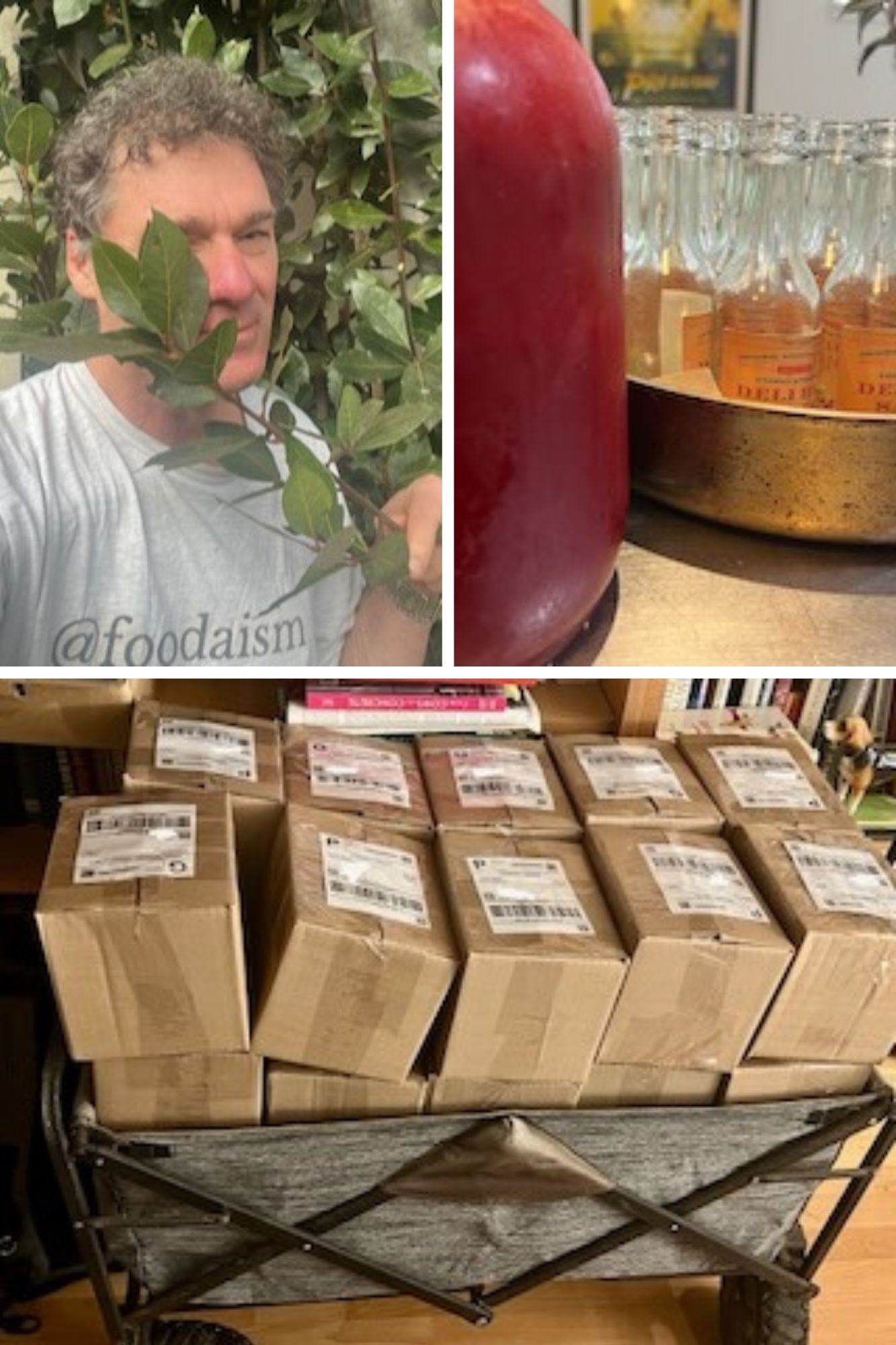
Another batch of Foodaism happy boxes just went out, and you’ll want to get on that wagon. When you join Foodaism, you get bay leaves picked fresh from my garden. And when you join for the year, you’ll get a bottle of my new batch of homemade Eshman & Peshkin Deli Hot Sauce, fermented with Fresno chiles and…beets! You can’t get this anywhere except our dinner table — or by joining Foodaism. (Founders get all this and my freshly-baked biscotti!)
If you enjoyed this newsletter and its free recipes, please support it by taking a moment to join. And click on the gift button to send your friends and family a New Years gift they can only get from Foodaism!
There are only so many substacks I can pay for. Beyond that, hot sauce is a reason not to.